Evidence Based Design

Design—especially growth and product design—is often a battleground where many forces compete in shaping decisions. User needs, business impact, designers’ personal experience, stakeholders’ intuition, industry trends, and now even AI enter the conversation. While this diversity of inputs can generate creative ideas, it can also make it difficult to determine which signals should actually guide critical design decisions.
In practice, many product decisions end up being influenced by authority, anecdote, or design trends rather than structured evidence. Designers may rely heavily on intuition or stakeholder opinions, while teams struggle to determine which proposals truly deserve prioritization. As products scale and the stakes of design decisions grow, relying purely on intuition becomes increasingly insufficient.
In this sense, the role of a designer making critical product decisions resembles the role of a physician determining a treatment plan. Physicians must identify the underlying problem, understand patient concerns, review available scientific evidence, and combine that information with clinical expertise to determine the best course of action. Modern medicine has developed a rigorous framework for this process known as Evidence-Based Medicine (EBM).
Evidence-based medicine emphasizes that medical decisions should be guided by three elements:
The best available evidence
Clinical expertise
Patient values and circumstances
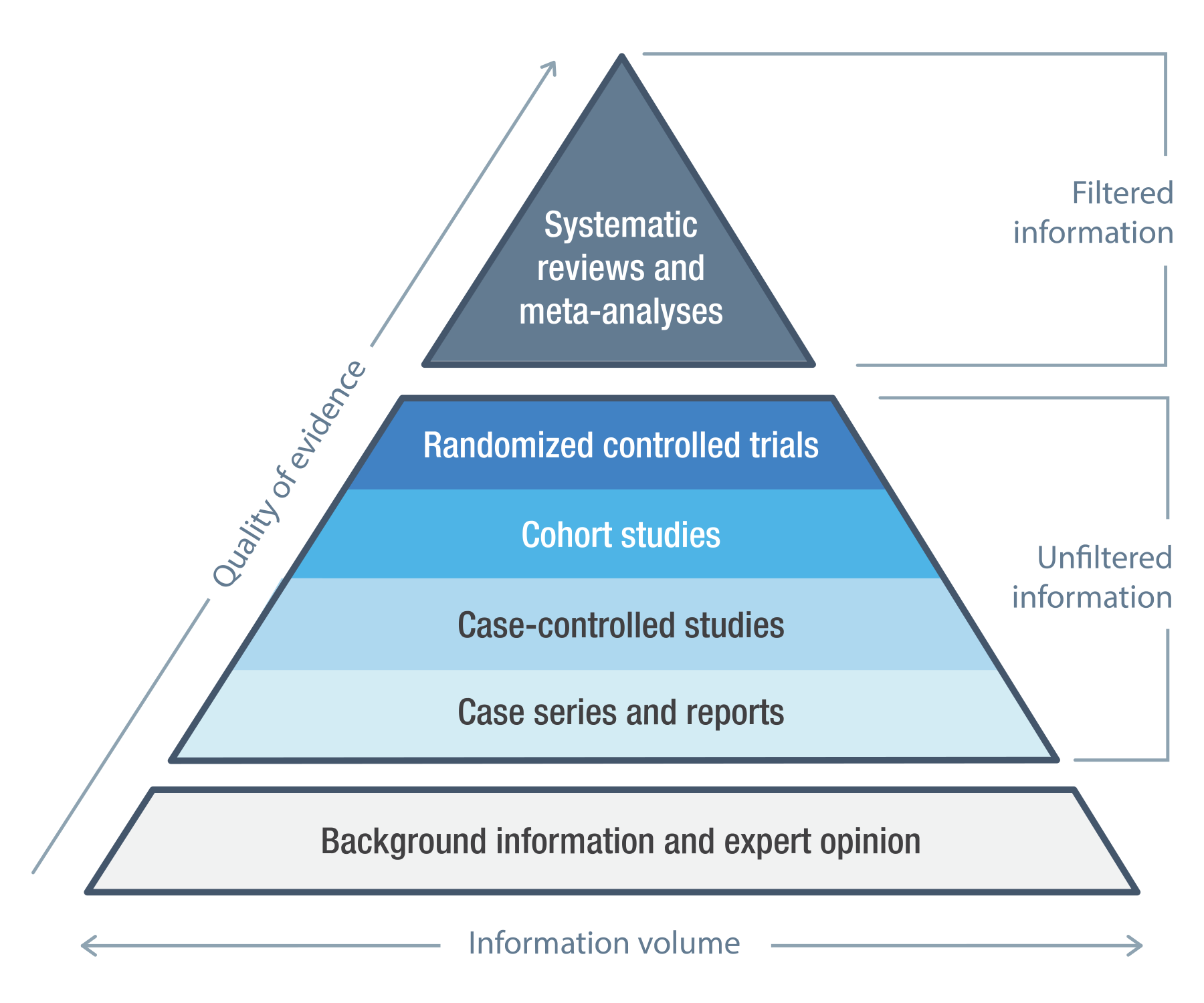
A similar framework could be valuable in product design. Designers also face complex decision environments where data, expertise, and user needs must be balanced. Borrowing from this idea, we can imagine an approach called Evidence-Based Design, in which design decisions are evaluated and prioritized according to the quality and relevance of available evidence.
Evidence in Design Decision-Making
Not all evidence supporting a design decision is equal. Some signals are stronger and more reliable than others. Understanding the relative strength of different evidence sources can help designers prioritize ideas, design better experiments, and avoid being overly influenced by weak signals.
Level 1 — Replicated Experiments
Multiple controlled experiments producing consistent results across different cohorts or time periods.
Level 2 — Well-Designed A/B Experiment
A randomized experiment with sufficient sample size and clearly defined success metrics demonstrating improvement.
Level 3 — Observational Product Data
Strong performance differences observed through analytics after implementing a change, even if a formal experiment was not conducted.
Level 4 — Usability Research
User testing showing that a design improves task completion, comprehension, or satisfaction.
Level 5 — Industry Patterns or Competitor Research
Patterns observed across other products that may generate hypotheses but do not provide direct evidence of effectiveness.
Level 6 — Expert Opinion
Input from experienced designers, product leaders, or stakeholders based on intuition and prior experience.
Even within each category, the quality of evidence can vary significantly. A poorly designed experiment with a small sample size or biased metrics may provide weaker evidence than strong observational data. Similarly, qualitative research with only a few participants may reveal useful insights but should not be overgeneralized.
Therefore, evaluating evidence requires attention to factors such as:
• sample size
• experimental bias
• reproducibility
• measurement validity
• potential confounding factors
Without these considerations, teams risk placing excessive trust in weak or misleading signals
Evidence Is Only One Part of the Decision
In medicine, evidence alone does not determine treatment decisions. Physicians must also consider patient preferences, risks, side effects, and contextual factors.
Design decisions operate similarly. Even if evidence suggests that a design improves short-term metrics, teams must still evaluate broader consequences such as:
• long-term user trust
• accessibility and inclusivity
• brand perception
• technical feasibility
• regulatory or compliance risk
For example, certain “dark pattern” design techniques may improve short-term conversion metrics in experiments but damage user trust or long-term retention.
Therefore, evidence should guide decisions, but it should not be treated as the sole determinant.
The Role of Designer's Expertise
Evidence-based approaches do not eliminate the role of design expertise. Instead, they help structure how expertise is applied.
Experienced designers contribute by:
• interpreting ambiguous signals in data
• identifying promising hypotheses to test
• understanding contextual constraints
• recognizing long-term implications of design choices
In this sense, evidence does not replace design intuition—it grounds it.
Divergent Thinking vs Convergent Decision-Making
Many established design methods, including design thinking, place strong emphasis on divergent thinking—generating many ideas, exploring possibilities, and encouraging creative exploration.
While this phase is essential, successful product design also requires convergent thinking: the ability to evaluate options, prioritize solutions, and commit to decisions.
Evidence-based design provides a structured mechanism for this convergence. By explicitly evaluating the strength of different evidence sources, teams can:
• prioritize hypotheses
• plan testing sequences
• reduce decision paralysis
• prevent overreliance on opinion or authority
In other words, evidence helps designers navigate the transition from ideation to decision.
Toward an Evidence-Based Design Culture
Adopting evidence-based design does not mean every decision must be supported by perfect data. Instead, it encourages teams to continuously improve the quality of evidence behind decisions.
One useful concept in this context is evidence debt—the accumulation of product decisions made with limited or weak evidence. Over time, unresolved assumptions increase risk and uncertainty. Identifying and addressing evidence debt through research or experimentation can help teams strengthen the reliability of future design decisions.
Ultimately, evidence-based design aims to elevate design from a discipline driven primarily by intuition or authority to one grounded in structured reasoning, research, and experimentation. By combining evidence, expertise, and user understanding, designers can make decisions that are not only creative, but also accountable and effective.